Sunday, August 27, 2006
More to Come


Tuesday, August 22, 2006
Day 6 and 7 Photos
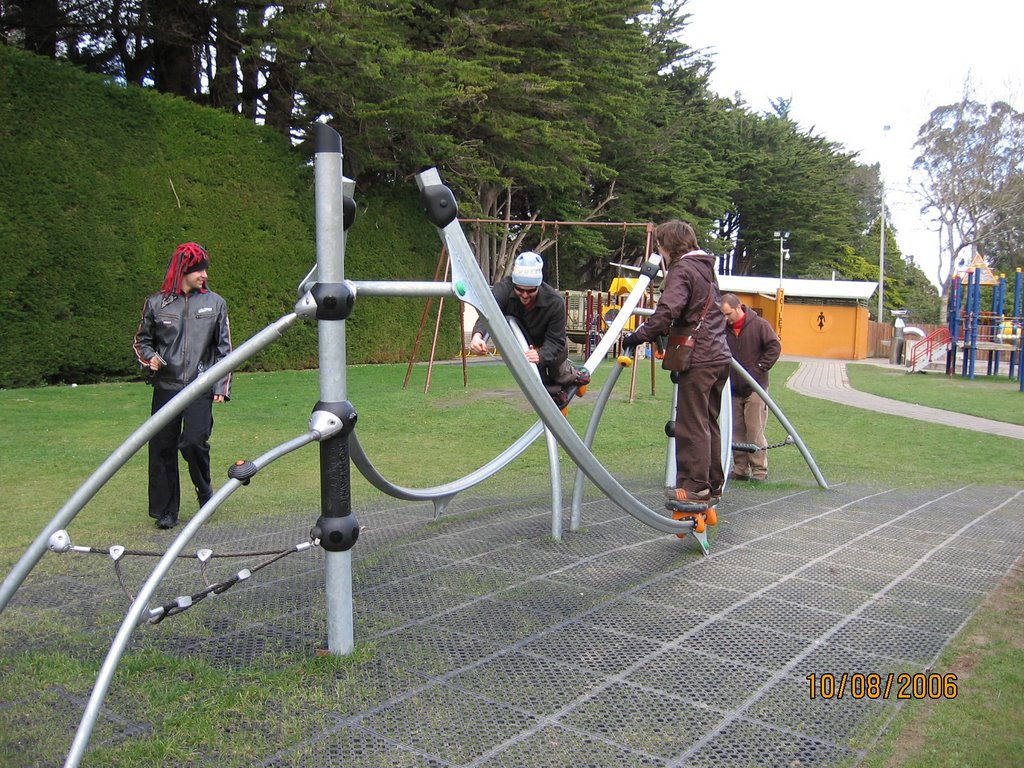
One of the pieces of new, unfathomably dangerous (and, so, fun) playground equipment at Queens Park. This one was like a skateboard that you could slide back and forth while standing on.

Another piece of equipment. This one spins while people try to run around it. Sounds perfectly safe, no?

Scenery in the park. It was a quite lovely park, fully of trees and hills and water and other scenic things. It was, however, sadly lacking in run-ins with ducks and squirrels and gay men in the public restrooms. Our parks win on those counts.

The brewery. Not what you'd call a big operation. The barrel has all of the empty bottles that our samples came from. 5-6 liters total, I think.

The family at dinner. We joked that all of our pictures were taken at the dinner table or not at all. Though it was a joke, after looking through the pictures it was mostly true. From left to right: Darrell, Karen, Sara, John, Ami, Peter, Libby, James, JF, and Molly.

I forgot to mention our discovery of the photo taking and editing program on Darrell's new macbook. We spent a solid hour entertaining ourselves with these pictures. This is Ami.

And John.

And Karen. They weren't this dark originally, I hope they turn out well enough to see on the blog. I would recommend everyone buy a macbook just so you can play around with this program. We ended up with something like 150 pictures of all of us in various poses. Of course, now most of them seem significantly less amusing, but what can you do.
Days 6 and 7
Days 6 and 7 were more pretty easy days. Unfortunately, Libby contracted some travel funk, which set in around our third day of travel and still hadn’t let up by the seventh day. In fact, both the sixth and seventh days she was pretty wiped out by it. Molly and JF came into the first flight feeling similarly, and JF was still suffering slightly from it even by the seventh day also, so it’s possible that Libby got it from them. However, since we spent nearly a day aboard a plane with around 200 people with god-knows what ailments, it’s impossible to specifically lay the blame on
The upside is that I’ve finally, more or less, adjusted to the time-zone. I’ve been able to stay up until
On Day 6 we managed to get out into the city for the afternoon and see a few of the sites available, such as they are.
The first was
Sara works at
Also in the park there is an aviary (pronounced “a-vir-ee” here) filled with many colorful local birds: parrots, pootafoots, cocktrices, dongilmongrenals, whooping ducks and many other strangely named (as all things are down here) birds. It would appear that I’m also not entirely interested in birds either. As was stated in an earlier days’ log, though,
After the park we visited the
Yeah, OK, I can’t continue on with that. It’s verbatim from the flyer I picked up while we were there because I couldn’t remember anything of particular interest being in the museum. It had a gift shop that had a nice selection of jade jewelry—at least Libby thought so because she picked up a few more pieces there. I didn’t do much more than scan over the things in it. The museum itself, by small town standards, was quite large, pretty well done and it had a few interesting exhibits. I’ve always loved the idea of museums—places where old things are stored so people can see what things used to be like. History, culture and how society works are all very interesting ideas and lord knows people need to study more of it. In application, though, I find myself walking around from one exhibit to the next, reading about one out of twenty randomly selected cards about how the adz was an essential tool or how some people were miraculously saved from freezing to death in Antarctica or some other supposedly non-fictional land and I find myself, sadly, unengaged. This, it should be noted, is not the fault of the museum, it is my own. I have been equally unengaged in the Smithsonian. It is a fault of my character, I am sure, and I do not wish to detract from the enjoyment that people who love museums would receive from visiting this establishment. Just don’t bring me along, please.
This museum did have a living display of tuataras, a strange lizard that I’ve been told has a third eye when it is young. This eye, which undoubtedly sees either into the future or straight into the souls of other tuataras, is eventually covered up by skin. I guess this happens when the tuatara is old enough to not care what the future brings or it has no further need of reading souls. Nature is truly a mystery. To me at least it is.
After the museum we walked over to the Invercargill Brewery, because we hadn’t learned enough about how local beer is made yet. Actually, we were hoping for some free handouts, and we weren’t disappointed one bit. The owner, whose name escapes me, was a very friendly bloke who welcomed us into the brewery for a “tour” roughly an hour before closing time. The tour consisted of us walking in from the street into a surprisingly not large room where the brewing took place. He pulled out three, liter bottles of beer (they make four different beers but their run of one of them had run out) and poured us a cup each. Then he went back and grabbed some more liter bottles because what he had brought would have only given us a taste, and he wanted to supply us with a solid half-glass of each sample.
We spent the hour in there tasting all of his beers and hearing how he made and marketed his beer. We also learned how he came to set up his brewery, which started outside of town, and how he made the move into town. It was, to me at least, much more interesting and applicable than the museum tour had been. Interesting because, even though I don’t have much of a personal taste for beer, I appreciate much of what alcohol has to offer and applicable because that word sounded good when I wrote it in there a little while ago (it’s not like I have any ambitions of opening my own brewery, so where would I “apply” what I found out?). After the tasting we went into his small sales room and bought $100 or so worth of beer, so his time wasn’t a complete waste. I also experienced, for the first time, the refillable beer container. Liquor stores also have this feature, where people can bring their own containers—usually two liter bottles—and fill them with beer straight from a tap instead of paying extra for bottles or cans. It’s really quite an ingenious idea, if the beer can be drunk before it goes flat (which would probably be fairly quick).
It was during Day 6 that we began to make fun of some of the
Within a day or two I discovered that my name in
I have also come to personally love the way almost any concept can be slanged with the addition of the simple word “as.” This is a rather common phenomenon and even made an appearance in an advertisement circular while we were here. For instance, say it is very hot outside. The clever observer could say, “It’s hot as.” Naturally, those unfamiliar with the slang would be inclined to ask “Hot as what, milady?” (because people unfamiliar with the slang are, naturally, butlers). This answer, however, is entirely up to the listener to supply. It can be as hot as whatever. The circular I kept was for a camera store and it says on the front page (Fat As Deals at Skinny As Prices). We have become quite enamored with the concept of As-ing anything we could over the past few days. Jamie, I think, has come up with the most colorful so far. When describing food, he said it was “yum as.” I am fully planning to take this habit back to the States. I might also allow my students to use slang in their papers, but only if they As them up, just to try and spread it around as much as possible. So, in a few years, if people in
Mostly, though, I have been trying to get Ami, who is a native Kiwi, to say comical sentences including the word “deck.”
“Ami,” I would say conversationally, “say ‘I like to jump up and down on decks of many sizes.” To this the entire family laughs because we are, apparently, a group of perverts who like to laugh at the expense of others. I always knew that I, personally, was, but I am always surprised when others have my same sense of humor. And the humor lies entirely in how they say the word “deck.” It usually sounds like “dick.” “Ami, say ‘I like to erect decks in people’s backyards.’” “Ami, say ‘I love to bounce around on big black decks.’” And on and on. I am really quite hilarious. So far, she has completely failed to participate in my juvenile attempts to make fun of her language, and I can hardly blame her. It is truly a remarkable aspect of the American persona that I, a foreigner, could come to another country and make fun of their language instead of them making fun of my language. But things are as they are, I suppose. And it is funny, I don’t care what country you are from.
Later that night and, embarrassingly, through much of Day 7, I did something that I honestly never thought I would spend a significant amount of time doing: playing a role playing card game. Pete is an avid collector and player of Magic: The Gathering cards, and late on the fifth day he talked JF into playing with him. JF played a game and then spent several hours in a little world with Petie creating a good deck for himself. The rest of us spent our time drinking wine and laughing at how clever we consistently were—which, in fact, we often were, this family could make a fairly successful reality program, I think. Eventually, we four international travelers went back to our hotel. Libby and JF were still not feeling well, so it wasn’t very late at all.
The 6th day I found myself sitting around the house all morning and early afternoon waiting for the John and Sara contingent of the family to show up for the day’s activities (Jamie and Ami were staying with them). The night before, they had stuck around, drinking, until fairly late and then went home to carry the party on. They were supposed to show up around
Ah, pie. The
So I was up and over to the Loves’ house (it’s only about three blocks away from our hotel, so we’re able to walk there and stumble back drunk, or at least tipsy, as we usually are, without needing a vehicle) by 8:45. Since I hate talking on the phone in America, I was trying to avoid using the one here in New Zealand entirely (considering it, like not having to drive for two weeks, a luxury of being on vacation—or holiday as they call it here), so I mentally refused to call over to John and Sara’s house to find out what was going on when they still hadn’t shown up by 10:00. With time to kill, I let Pete and JF talk me into a game of Magic.
Pete set me up with a deck that, I’m convinced, he knew sucked hard. Using his carefully constructed deck, he systematically destroyed and embarrassed me. JF lasted a little longer the first game but eventually suffered the same fate. It was short and, for Pete at least, sweet. We played another game with a slightly different strategy. Well, JF had a strategy, I suppose, but mostly I just died quickly again. He, however, was able to use my distraction to beat Peter, which made him “bored” with the game and we quit (this, we found out, was always Pete’s response to losing pretty much any game—he would be “bored” with it and quit, but, man, if he’s winning, he could play all day).
Later that evening, after the guys’ activities fell through (Libby and Molly went back to the hotel to sleep and Ami and Sara went out clubbing—and, to make our nerdiness obvious and in the name of complete disclosure, I suppose I should admit that we were planning to go LAN gaming, which involves all of us sitting around computers in a lounge playing the same game together, but the lounge was booked for the night so we had to go back to the house and occupy ourselves), the five of us—Pete, John, JF, Jamie and myself—decided to play a game of Magic.
After spending a little time getting a deck together for John, Jamie and myself (I wasn’t going to play with the stacked-against-me deck Pete set me up with before—he called it his “what were you thinking?” deck, since that’s what someone would ask the person using it after that person was completely and embarrassingly destroyed, and somehow he thought this was a fair deck to give me as someone just learning the game), we broke up into teams to help Jamie, John and myself who had almost no experience playing the game. We decided it would be fair for JF and Pete to be on a team. Even though they both knew what they were doing, we figured numbers would give us an advantage.
This was entirely not the case as they soundly whooped us twice.
This was all well and good. We had nothing better to do that night and Pete loved the fact that he was able to play his favorite game with his family (he especially loved the beating us badly part and, being the youngest, I suppose I can see why). Had we left it at that, it would not have been something to make us the potential target of ridicule—from people who have no experience with these types of games or who did not grow up mildly addicted to role playing games as I was (and still, I suppose, am in many ways since those are mostly the video games that I purchase to play at home).
On Day 7, we were really at a loss for anything interesting to do. I did finally get to start my day with a pie, so that made me happy (it was everything I hoped it would be and more—steak and cheese with plenty of brown gravy oozing out the sides with every bite, it was like a brown, greasy jelly donut and wonderful). We had to stay near the house to receive a package that was being delivered for the big party we were having the following night (salmon that we had shipped from the salmon farm covered earlier, which we knew couldn’t sit unattended on a porch while we were out of town for the whole day), so we had to plan our day accordingly. Since Karen was starting to feel ill herself, we decided that another day of doing mostly nothing sounded just fine. “Mostly nothing,” in this family at least, means shopping. Those who decided this sounded like a splendid idea (obviously not including me), thought hitting the second hand stores, here called Op Shops (which stands for Opportunity Shops), would be fun. So everyone but John, Darrell and me headed out around
Again, this left us, John and I, with nothing to do, so we pulled out all of Pete’s Magic cards, convinced that we could come up with a deck and strategy that would allow us to beat him and JF, finally. I should be embarrassed to admit that John and I sat at the table for the entire time they were gone sorting through and reading cards, trying to figure out what would work best against them. Of course we were already at a disadvantage because both Pete and JF had already gone through all of the decks picking out the best cards, but we figured we could make up for that with sheer numbers again.
After three hours of deck creation (we kindly fixed Jamie’s deck too, even though he was so lame as to run off to shop with the girls instead of staying behind to play with cards) everyone came back and it was established that the boys had a score to settle in the kitchen. A “No Girls Allowed” sign was put up on the door to complete the ambience (and which was totally ignored) and we set about our business.
Eventually, the girls decided to go shoe shopping since we were doing stereotypical boy things in the kitchen, which was great because it gave us a few hours of uninterrupted time. We used that time to, once again, get trounced by Peter and JF. We put up a better fight, though, and finally decided to separate the teams differently. JF and Pete would have to be on different teams, and, since Pete had the best deck, he would get one of us on his team. This, unfortunately, didn’t work out so well for Pete. Without JF there to tip the scales in their favor, Pete and his partner (remember, John, James and I all still sucked at this game, so we were more cannon fodder or, at the very least, shackles than anything else) lost twice. After the first time, Petie was bored with playing, but we forced him to play another game. By the end of the second game, he had pulled out his handheld Nintendo and started playing it before he was even dead, so we called it a day.
Nothing much of note happened the rest of the day. We made another attempt at the LAN gaming, to cap off our already thorough nerd-fest, but quickly tired of it because the people who worked there kept jumping into whatever games we were playing and kicking our butts. Lame as.
Monday, August 21, 2006
The Peeing Across New Zealand Part
The idea of this theme occurred to us as we were driving on that first full day because, as we stopped at every small town on the road, I needed to break off to find a restroom. Then jokes were made that my goal must be to pee in every restroom I found along the way. This, of course, everyone in the van found awfully amusing--myself included--so I adopted it as my vacation's theme.
That said, there is only so much description of restrooms I can include in each post before it gets boring and, more likely, ridiculous. Suffice it to say that I did, in fact, use pretty much every restroom that I found along the way. However, with a few exceptions, there were relatively few that were worth commenting on. They mostly followed the theme of being a place to relieve myself and little more of interest could be drawn from them. There were two notable exceptions.
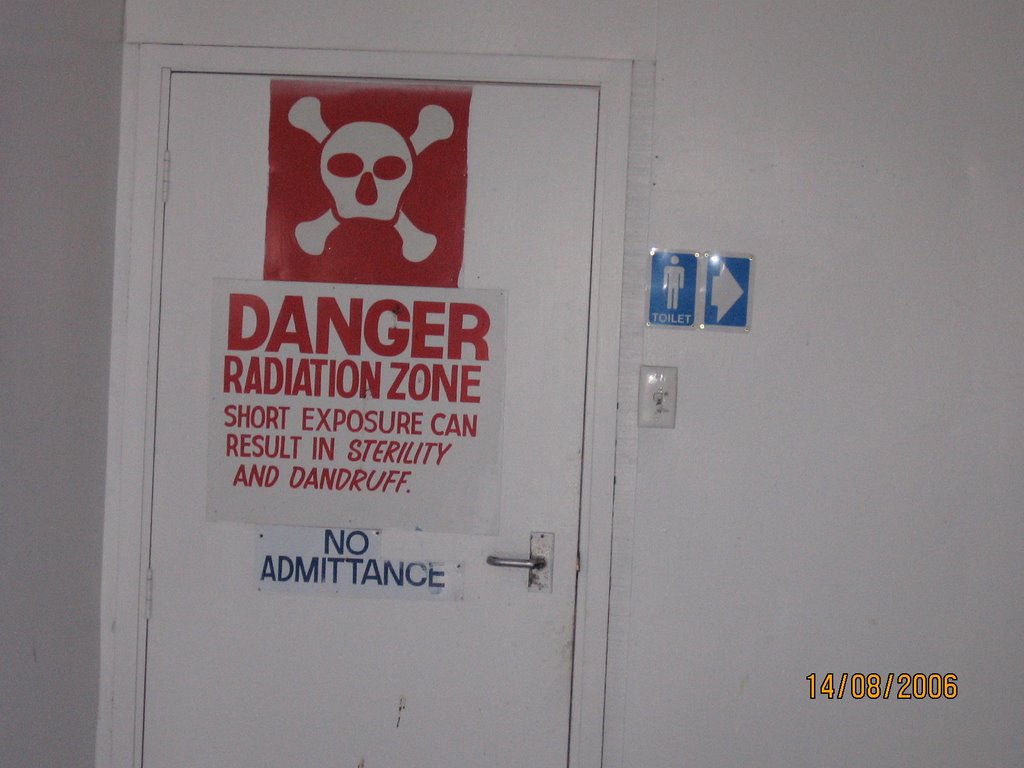
The first was in Riverton, where a very amusing sign was situated directly adjacent to the men's restroom. I will include the picture here because it is, I think, one of the best signs ever, and the fact that it was so near a necessary facility gave it that much more of an impact.
The second was in El Tigre, the very posh restaurant where the family held Darrell's 60th birthday party on, I think, our 11th day (I haven't finished writing that day's travels up yet, so I can't remember for sure if it was that day or not). If you ever find yourself in El Tigre, the handicap accessible restroom comes HIGHLY recommended. There were little, neatly folded hand towels and everything. The non-handicapped restroom was paled by comparison. And, no, I wasn't denying any more deserving handicapped person access to the restroom by using it--by this time in the evening we were the only people still left in the restaurant, and they only have two restrooms--the other of which someone else was in--so I figured there was no harm done by my using it. I didn't, however, take a picture because I didn't have the camera with me.
So, there. That's all I can really say about the theme. Just trust that I DID use "toilets" pretty much everywhere in the southern island that we stopped. The restrooms were only slightly varied, though, so there wasn't much more that I could say about them after I described the toilets that most of them had in common (see earlier posting).
Hope that clears things up for everyone!
Sunday, August 20, 2006
Days 4 and 5 Photos

Before leaving Te Anau, we stopped for another statue picture, this time of a takahe.

A picture of one of our meals--I dont' remember if this was day four or five, but I thought the wine bottles on display (with beer as a side) were telling.

Fat Sheep, who was surprisingly prone to being chilly, sitting in front of the space heater in our hotel room.

The sign for Demolition World, starring the wrestling tag team who were completely absent during our visit.
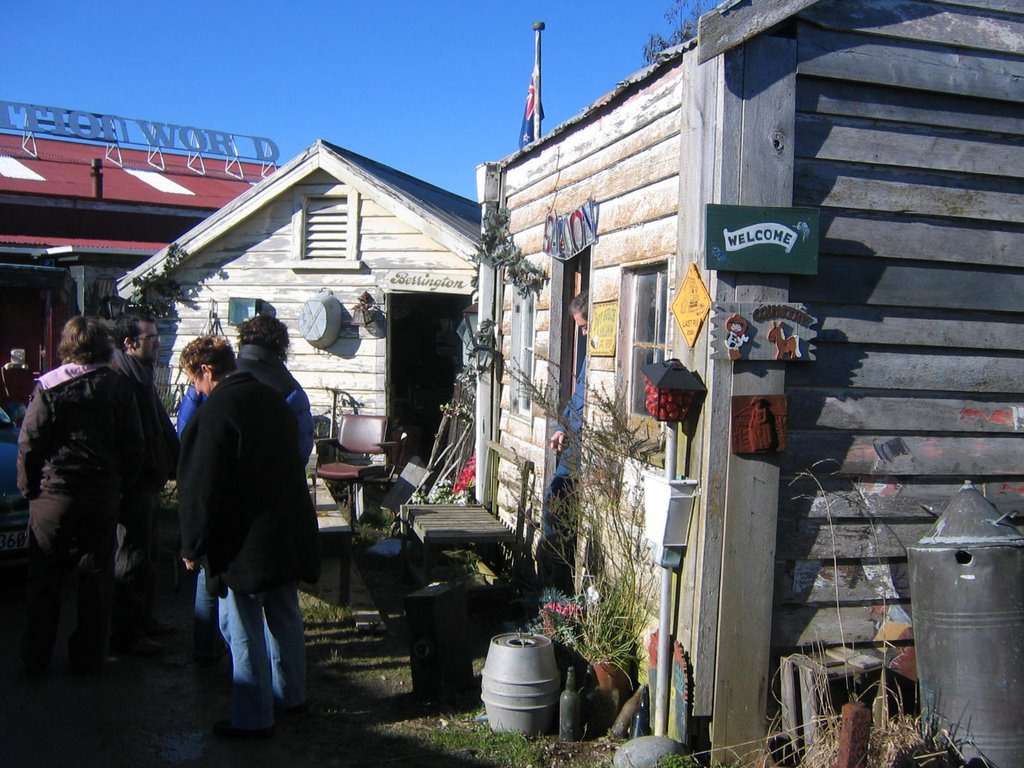
A sampling of the buildings in Demolition World. There were, I think, more than a dozen different buildings, each furnished and decorated inside and out.

Another picture in Demolition World.
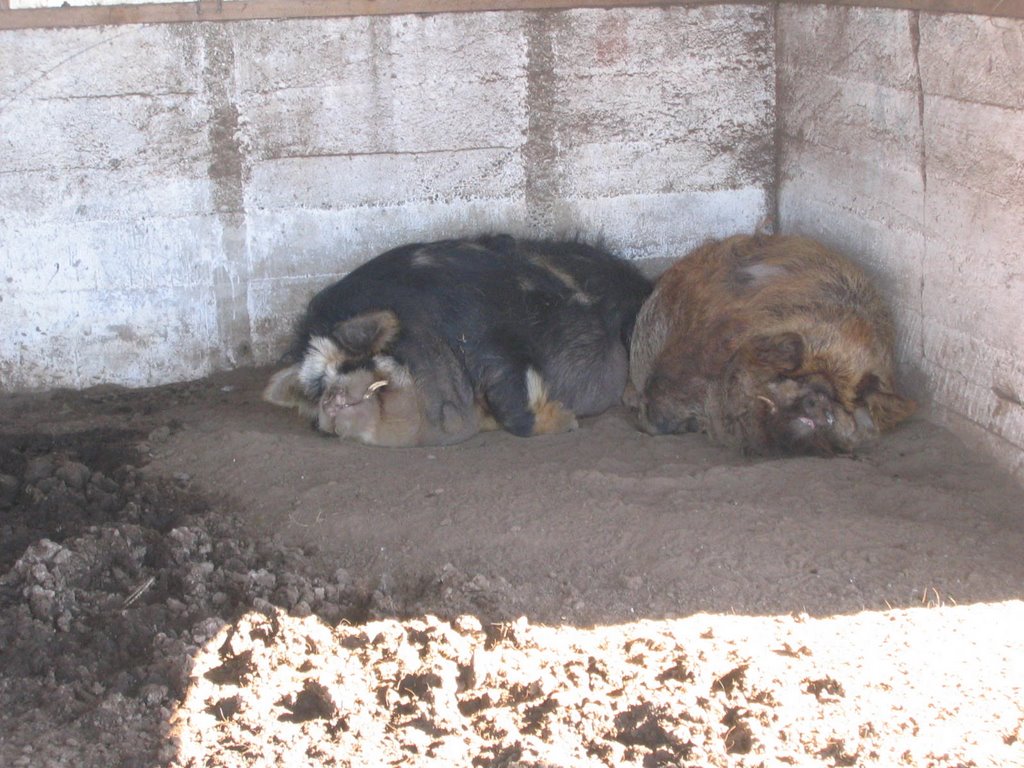
And, finally, the morbidly obese pigs that were at Demolition World. They refused to get up and move around while we were there, and I can't says as I blame them. Their legs would doubtless collapse.
Days 4 and 5--Invercargill
Travelogue Day 4 and 5
Day 4 was a comparatively uneventful day. After cramming in a considerable amount of what there is to do on the
At this point it goes without saying that the trip down was very scenic, filled with more mountains (well, mountains by my central
Hearing this made me think back to the days of working cattle when I was growing up. It was the standard for the younger of us, who invariably were stuck in the “chute” pushing and prodding the animals up to where they would be worked over however we were working them over that day, to get the crap kicked out of us by the animals. More than once I had the extreme displeasure of knowing what it’s like for a couple hundred pounds of irritated animal to personally—and I think maliciously—try to end my chances of creating offspring. Remembering this, I felt a little sorry for the people who would have to do something similar with a flightier and more dangerous animal. And then I laughed a little inside because it wasn’t me and in many ways I’m a very petty person.
We only stopped once on the road in Winton where we had lunch at another great little roadside café. . It’s really great how every small town along the road has so much to offer. I imagine it’s a lot like the towns here in the States were before the major highways diverted all drive-by business to the bigger cities. Probably there were more sites we could have visited on the way, but we were still in a dozing state whenever we were on the road and I think we managed to sleep for most of the trip
In Invercargill we found our hotel, checked in and met up with Libby’s two youngest brothers, John and Pete. Of course, both of them were overjoyed to see us because we have that effect on people. John and his partner Sara also live in Invercargill and later, when Sara got off work, she joined us at the house. Mostly we spent the rest of the day chatting. Also, not surprisingly, the wine was broken out. Since we were still pretty travel-worn, though, we ended the night pretty early back in our hotel.
Travel Note: Earlier I briefly discussed the nature of the weather and heating here in
Remarkably, even though the temperatures, even in the warm parts of the year, are likely to get cool, I have not yet been in a house or establishment with central heating. This is a foreign concept to nearly everyone here. John noted that it was because of electricity and burning fuel availability, which makes some sort of sense.
Electricity, since this is a small, pretty much self-contained island (from an energy perspective at least), would be in fairly high demand and the prices would reflect that. On the other hand, there seems to be an abundance of coal on the island and, obviously, no shortage of trees to burn. During the building booms that have happened in previous decades, it made more sense to include fuel burning stoves that could heat good portions of the house than to use electric heating of any sort, and, despite many obvious advances in the field of central heating, New Zealanders have stuck to this idea. More often than not, rooms are individually heated—using electric radiators or space heaters wherever necessary. Nearly every room in a house has a door so that it can be isolated from the rest of the house and the heat can be trapped.
This is a great idea, unless you have any intention of being in more than one or two rooms in your house and you like to be warm. Among the most uncomfortable experience that I’ve had while here happened in one of the earlier hotel rooms we stayed. The bathroom had no heat and it wasn’t close enough to the heater to receive any of the heat. It was freezing in there. In some ways it made me feel like a rugged explorer, expelling my hard-earned waste or showering away the remains of a back-breaking day of running off the natives or whatever. In most ways, though, it made me feel clammy and cold (and then blind when the fog rose from the shower and filled the non-ventilated room) and when I stepped out onto the cold floor or sat down on the toilet seat that maintained the same temperature as a playground flagpole in the dead of winter (I totally should have dared Libby to press her tongue to the seat to see if it would stick, I’m sure she would have done it in the name of good fun), I spent a good deal of time cursing the backwards planners who allowed something so horrible to happen to me at 6:00 in the morning.
John and I were discussing the lack of central heating and he told me that the typical Kiwi response to such an observation would be to “toughen up” and deal with it. This seems like exactly the response I would expect from many of the people in this country, and it’s not surprising since most of them have never experienced the benefits of central heating and/or a working thermostat (another drawback is that rooms often get too hot or too cold because the settings on the heat sources aren’t terribly responsive—the one room we’ve been in that had an honest-to-god thermostat in it was exactly as unpredictable as all of the ones that didn’t). I was also told that new construction was adopting a sort of central heating that did a little better job of keeping the house as a whole comfortable, though I doubt I will get to experience first-hand how they were able to muck this up too while I’m here.
Invercargill
Invercargill, I’m sad to report, is awfully dull by the standards of the rest of the cities we’ve visited so far. That’s not to say that there is anything particularly wrong with the city. Invercargill is located in the flattest part of New Zealand that we’ve been in so far—it is at the southern end of Southland and quite near to the bottom of the whole country. This means that, from a scenic perspective, Invercargill is about as dull as our towns in
The town itself is smallish, and, as such, the people have a very distinctive small-town attitude. They are friendly and very considerate, in a way that reminds me of how people used to act (in my memory, at least) in the smaller towns back when I was growing up (which is not how they act so much anymore). Just around the corner from our hotel, there is a small grocery and convenience store where we had planned to do much of our shopping to stock our room and buy all of the amusingly-named and amusingly-conceived foods that we were planning to bring back to the States as half-hearted souvenirs for friends and family (sorry friends and family if this ruins the surprise). I went in there and gathered up an armful of product and took it to the counter.
When preparing for this trip, we were informed that
On my second trip in, I had the debit card. She swiped that and I entered my PIN number, which brought back an “invalid card type” error. “Balls,” I said under my breath. I’d thought about breaking out a “bollocks” to test my vernacular but figured that would sound silly and pretentious coming from an American mouth (which doesn’t stop me from saying it when I’m home—“bollocks” is a great word, as are most of the British expletives that I try to use as often as possible). “Let me run back and get some cash, I guess.” To this she said something very surprising to me. “Just take the groceries with you and come back once you’ve had a chance to get some cash.”
This flustered me immensely. Under no circumstances that I could conceive would something like this happen to me in the States. Well, unless maybe I knew the shop-keep or something, but then I would have known what form of payment would be accepted. “No, no,” I dithered. “I will be right back.” But she kept insisting, so Pete, whom Libby had sent to be my grocery boy, grabbed the groceries and we went back to the hotel. I walked back to our room and put the groceries away, still a little shocked and surprised but mostly impressed that an act showing this magnitude of trust and consideration could still take place somewhere in the world of business. Then I borrowed some cash from Molly and JF and went back and paid the bill.
Whether or not this is typical behavior from the people in this city is beyond me. Maybe it was just an individual action by a young woman who, perhaps, had an undo consideration for Americans and wanted to make some sort of impression or maybe she was clinically insane and would be shortly fired because she kept giving away free groceries. Either way, I found it a most inspiring moment.
I do also have one story pertaining to Invercargill’s international reputation. Almost never does Invercargill make an appearance on the international stage. It has, really, only two claims to fame. The first is that Burt Monro, the character portrayed in The World’s Fastest Indian, a recently released movie starring Sir Anthony Hopkins, came from Invercargill. The movie, in fact, was also filmed here in the city and the back of Pete’s head even makes an appearance (they had a general casting call for extras and the back of Pete’s head was the only family member to make the cut).
The second happened in the late 60s when the Rolling Stones toured the area. After the concert, for reasons I haven’t been curious enough to fully find out because I can’t stand the Stones on any level, Mick Jagger referred to Invercargill as “the arsehole of the world.” Though I don’t think the city ever elected to put this on their signs coming into town, this was the reputation Invercargill had to live down for a very long time. In fact, the story is still circulating, so they might not have lived it down yet. I don’t think I agree that it is the world’s arsehole. I don’t think it’s anywhere’s arsehole, really. It might be a bellybutton or man-nipple by anatomical standards, but not an arsehole. I’ve been far worse places.
At any rate, our first full day in Invercargill was the first travel-free day that we had. Jamie, the second oldest in the family and the eldest boy, and his partner Ami joined us around
“Partner” is an interesting terminology used here in
With Jamie and Ami arriving, and Sara still scheduled to work, we kept the day’s events relatively low-key and mostly focused on, thank god, shopping. This was fantastic (the low-key, not the shopping, shopping is never fantastic) because it finally allowed Libby, the Canadians and I the chance to catch up on some sleep in the morning (though, not surprisingly, I was still up at
First the shops. What is there to say about entire streets of small stores that greatly range in nature that can’t easily be imagined by anyone who has ever visited such a row of stores before? It is possible to find some neat little items, of course, but it is also entirely likely that the same items will be equally available back home, and probably at a much cheaper price. Supply and demand is such in
As an example of pricing, consider this book that I found in a bookstore along the strip. There are several authors that I have discovered over the past few years that I have a bugger of a time finding in the States. They are British satirists and fiction humorists mostly, and, for some reason, our bookstores don’t keep their work in stock. Usually I end up finding them on Amazon because even the used bookstores on Ebay don’t carry them (because they don’t stock the books normally in the States to buy new so, duh, there won’t be any used ones available either). I was, however, able to find a few of these authors on the shelves of a bookstore here in Invercargill. However, the prices on the books were pretty over the top compared to what I would pay to buy them new on Amazon. Even though the back of the book would clearly state the Canadian price at $11, and the Canadian dollar is only slightly higher than the
And so on and so forth.
Things are pretty much the same for everything down here. This is why Karen and Darrell paid to have us pick up a Kitchenaide mixer and ship it down. It’s just that much cheaper, even with the high cost of shipping, to buy it in the States. Someone with business ambitions should really be establishing a toehold down here right now, because I expect there will be a real chance to make a buck once all the kinks are worked out.
Or maybe not. Which brings us to the other stop we made.
Demolition World
There was actually some debate as to the name of this place before we arrived. It was alternately referred to as
Demolition World is a quite entertaining way to dress up the concept of salvage. Any and all demolition in and around Invercargill is fair game for this company, and they can prove it with the multitude of windows, doors, construction materials and assorted bric-a-brac they have to choose from. In this way, they are not that different from a standard salvage yard. They have many bargains available to those who have enough patience to sift through the rubble. The thing that is different, however, is the way they present much of the materials.
The owners and the other people who work there have gone to the trouble of using much of their construction materials to piece together a facsimile of a village. There is no set time period, but most of the props and costumes seem to fall in the late 19th to early 20th century range. There is a school house and a church and a few bars and a few houses and any of a number of other types of buildings presented. Each of these buildings, then, is filled with mannequins that have been dressed up (actually, it’s a truly creepy number of mannequins living there—I’m reasonably sure I would be far too creeped out by all of the human shapes always looming around me to ever work in the place) and who are living in fully furnished worlds. All of the materials were salvaged from one place or another and all of the items are for sale.
In addition to the Demolition World that they have created, there are a number of animals—mostly of the farm variety, but including a building of more exotic birds—to entertain those who have little exposure to such animals. The people working there are happy to supply visitors with some bread to feed to the llamas, donkeys, chickens, roosters and ducks, and all of the animals were friendly enough. They also had two very fat pigs of a local breed. These pigs had small tusks and sleep apnea because they were so morbidly obese. Fat Sheep would have been quite at home with these real life animals who seemed too large to do much more than waddle their way to and from the food trough. I laughed outwardly, but not inwardly, at their absurdity.
From an economic standpoint this brought up a very interesting issue which John and JF were debating on the ride downtown. John observed that this type of facility stemmed from a desire to follow “conservationist” principles in
I don’t think I need to offer any examples to back JF’s side of the coin. People offer plenty of examples on a daily basis to prove that this way of thinking is pretty standard, at least in our part of the world. But I will offer an example that helps John’s case somewhat. Back in the 60s and early 70s, government officials planned to raise the level of
When word got out around the south island, many people rallied around the cause to save the lake, which is a gorgeous natural treasure filled with small islands that would have been completely submerged if the water would have been raised. Around 260,000 signatures were acquired and given to the elected government, who chose to ignore the clear desire of much of the population and press on with their plans despite popular demand. All of these government officials were quickly voted out at the first opportunity and replaced with people who were willing to save the lake. A significant boon for the nation’s energy supply—and any subsequent inconveniences—were deemed less important than saving a beautiful natural occurrence. Now the lake has to be maintained at a certain level and cannot fall below that level due to hydroelectric processing. I don’t know if I’m just jaded or what, but I have a difficult time believing that Americans would choose this course of action. But that debate is for another time.
Day 3 Photos
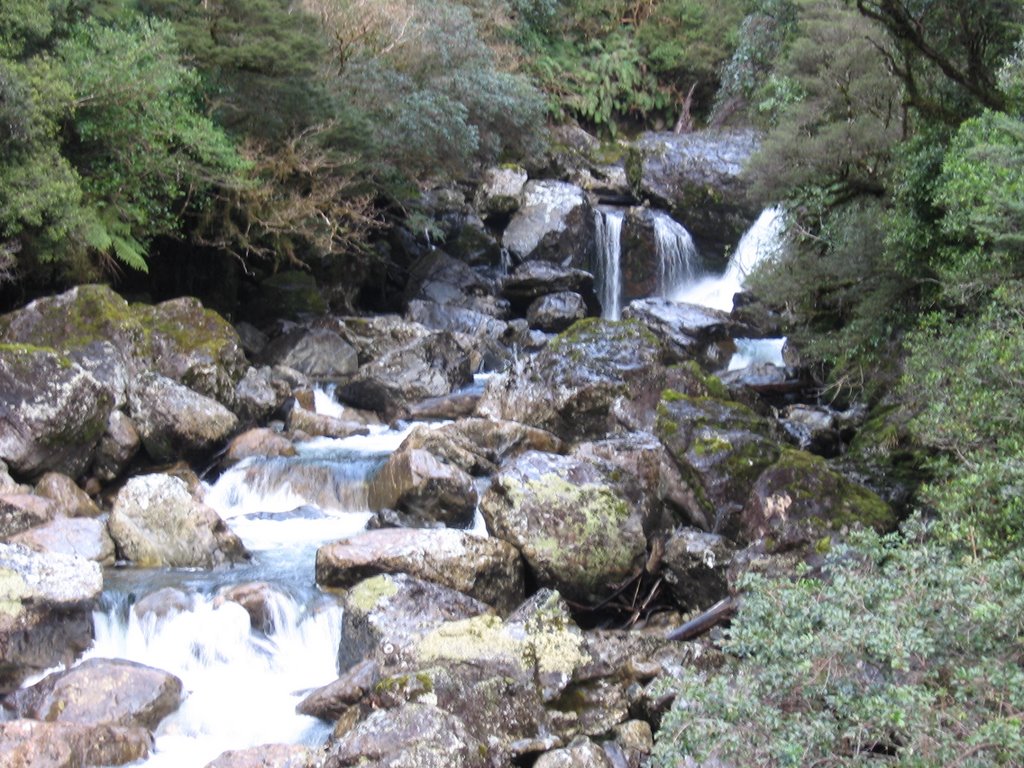
One of many waterfalls on the way to, and all the way through, Doubtful Sound. Our guide said that, when it's rainy, there are hundreds of waterfalls. He said someone counted over twelve hundred one time, but I'm not sure I buy that.
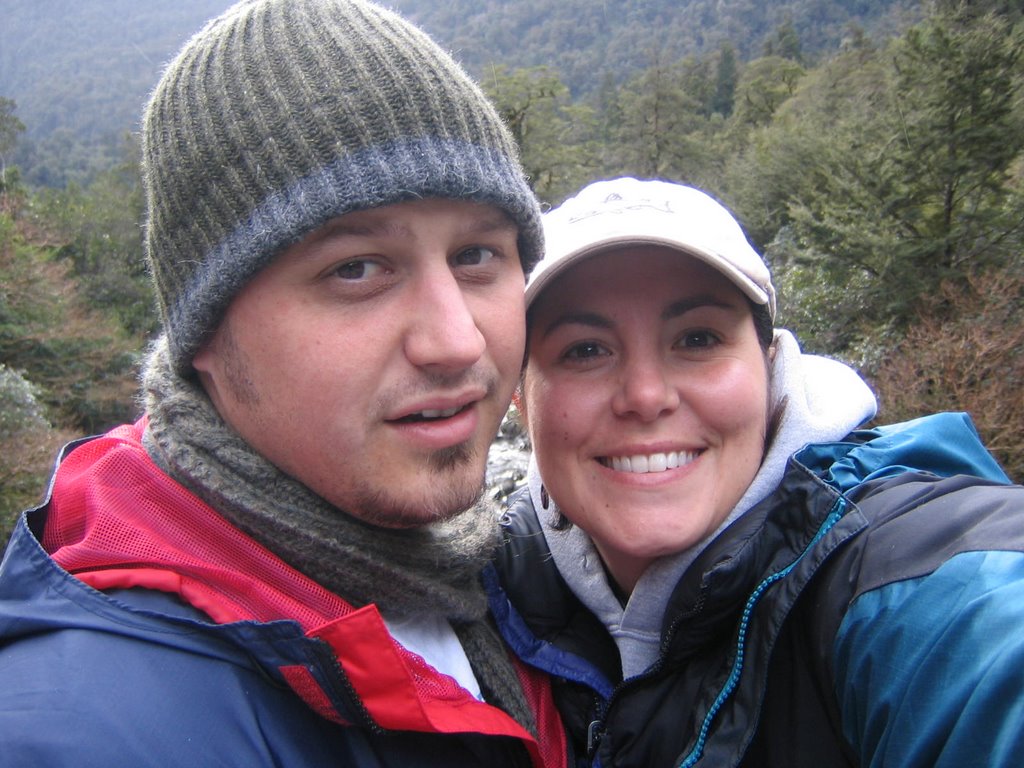
Pat and Libby with some trees and landscape and such.

One of the weird ass birds that is native to New Zealand, the takahe, which is flightless and awfully friendly. One could almost literally walk up and take a bite out of one of these birds. Sorry the picture sucks, it was as close as we could get and there was no way around the chain link fence.
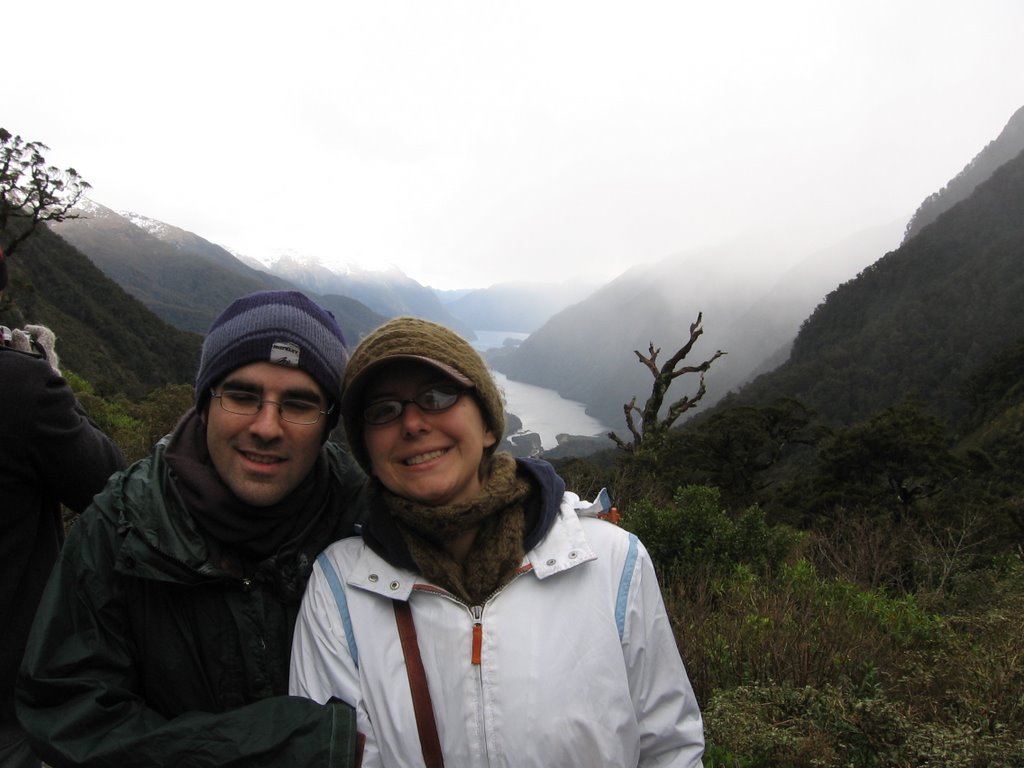
Molly and JF with Doubtful Sound in the background.
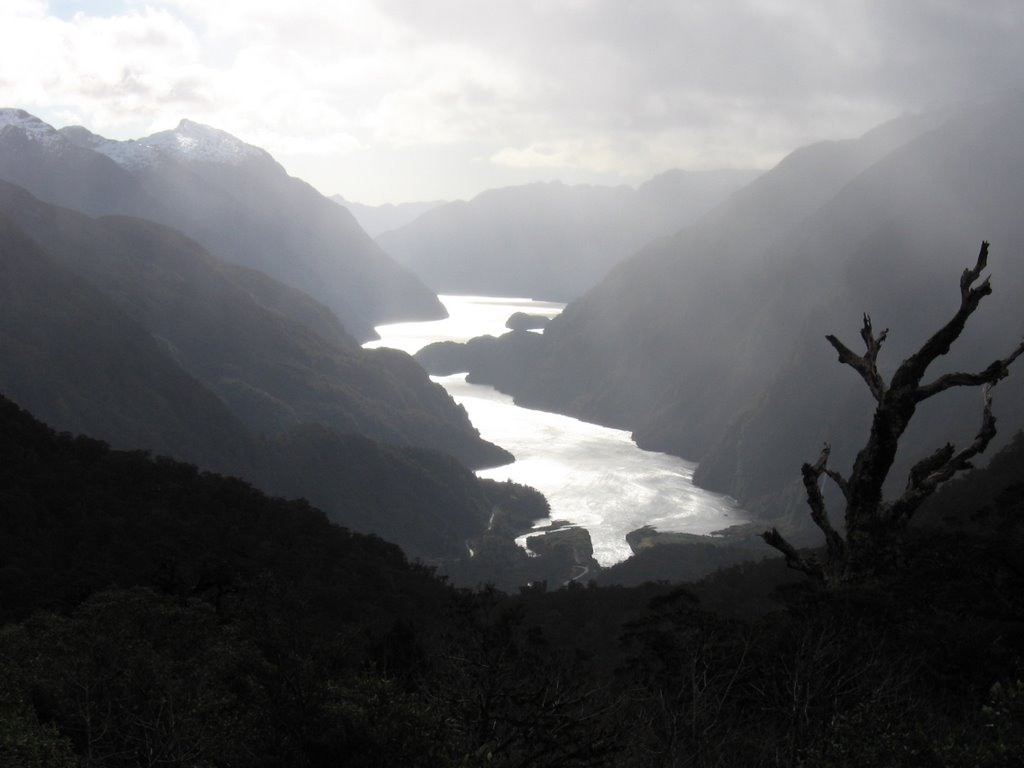
Pretty much the same picture as before, but sans Canadians. Interesting note, I've heard that Doubtful Sound isn't actually a sound, it's a fjord (which they spell fiord in NZ) because it was formed by glaciers.

One of the many peaks visible from the water in Doubtful Sound.

The hydroelectric plant situated between the lake and the sound. This is as exciting as it gets.

Pat and JF sporting their rain gear. Rain gear is awfully vital if one is planning on visiting just about everywhere we saw in New Zealand.